Tuesday, January 31, 2012

Fil-Am architect designing 2,000-seat Cebu Church–something that’s never been seen


Carlos Arnaiz, who’s also designing the Boracay airport, uses fresh eyes to keep from repeating himself

By: 


 0share59 51

NEW YORK-BASED Filipino architect Carlos Arnaiz JOSEPH AGCAOILI
Style is one word Carlos Arnaiz, a Filipino-American architect based in New York, tends to avoid when asked to describe what sets him apart from fellow practitioners. And he has a good reason to do so.
Aranaiz was in Manila recently to oversee projects. They include the Shrine of Mary, a Catholic church to rise in a reclaimed area in Cebu, and the new and bigger Boracay International Airport, a public-private partnership between the national government and San Miguel Corp.
“What I try to do is produce something that hasn’t been seen before,” he said. “Sometimes, I hope it’s something that I haven’t seen before.”
To achieve this, he and his team rely more on methodology. His “research-based” approach to doing projects requires him to focus more on their context as well as clients’ needs and issues that need to be addressed.
“People like to say that architecture is an art,” said Arnaiz, a product of Xavier School and International School in Manila. “I tend to disagree. For me, art is more utopian.”
Not that there hasn’t been utopian architecture, he conceded. But unlike painting and poetry, which don’t require a client, architecture requires one. The degree of collaboration between architect and client is usually an ideal gauge of how successful a project would be.
Arnaiz, who finished architecture at Harvard University, has been practicing for a little over 12 years now. After working for a number of firms in the US, he put up his own architecture firm in Brooklyn, CAZA or Carlos Arnaiz Architects, almost four years ago, and now employs a dozen or so associate architects from various parts of the globe.

COMPUTER-AIDED Marian shrine in Cebu

CAD of Cebu Shrine’s courtyard
Other than in the US and the Philippines, CAZA has ongoing projects in Colombia (Arnaiz’s mother hails from there), Brazil and Taiwan. The company has also done projects in Korea, Malaysia  and Costa Rica.
Master plan
Once finished, the Boracay International Airport, which is located in Caticlan, can accommodate more and bigger planes to and from the world-famous tourist destination.
“I’m quite excited about the Boracay project,” said Arnaiz, 35. “We’re not doing any construction yet, as we’ve just been through the master plan.”
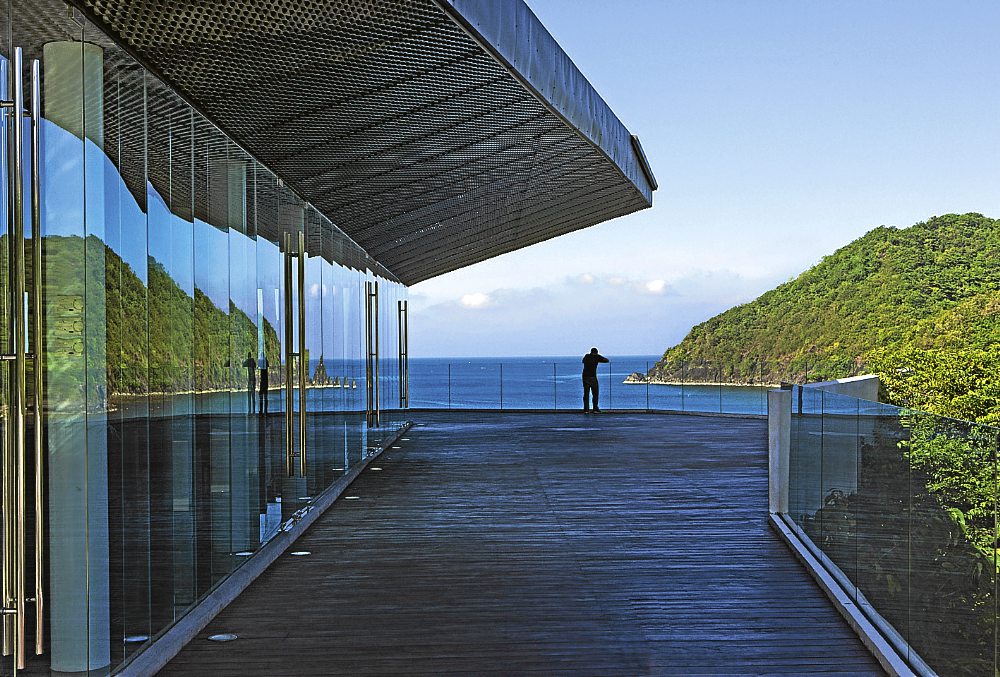
HAMILO Chapel offers worshippers panoramic view of lush greenery.

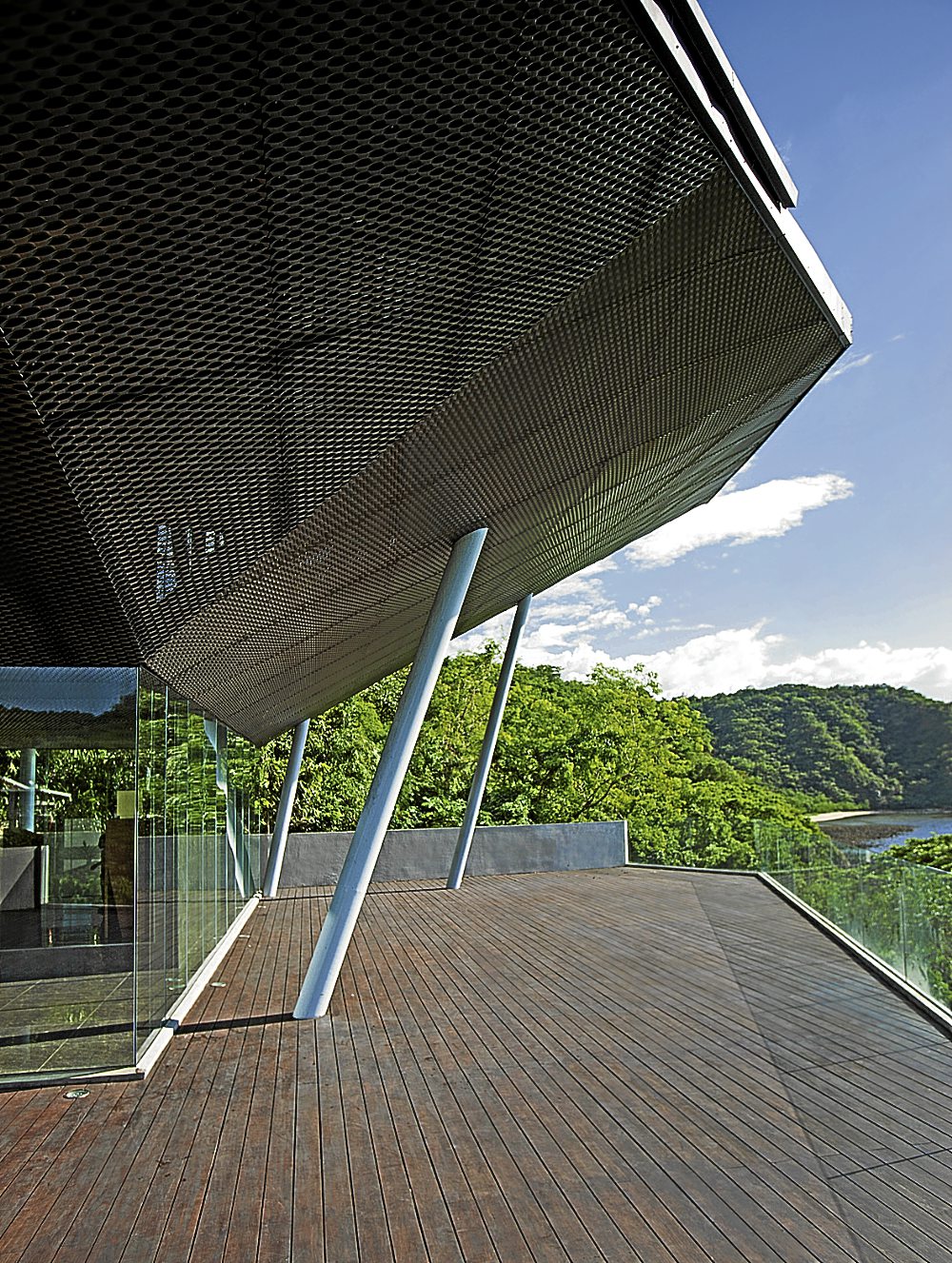
HAMILO Chapel at Pico de Loro resort in the Philippines
But the overhaul will be massive. The terminal building will be just one of eight new buildings in an airport that will be expanded from 800-2,000 meters. People behind the project will have to work around the old airport without disrupting current operations.
“One of the main challenges is how to make a responsive airport without making it, particularly the terminal building, too generic,” he said. “An airport’s functionality requirements are quite intense, but how do you make a building that’s relaxed? A lot of today’s airports feel overwrought. They’re trying to do too much.”
The 1,000-seat, 2,220-sq m Shrine of Mary is in the South Reclamation Zone in Cebu. Arnaiz plans to create a main entrance set against a series of walls with varying heights.
The project is financed by SM, which is building a mall complex in Cebu similar to SM Mall of Asia in Manila.
The entrance evokes the mystery one supposedly experiences while wandering through a mythical forest. The series of walls symbolizes the many paths and obstacles one goes through to arrive at one’s own enlightenment, said Arnaiz.
“Construction started this month. The building should be finished before the end of 2012. The owners’ goal is to have Christmas Mass celebrated in the church this year,” he added.
CAZA is also into urban planning and gentrification. The company will have a project with the Cebu City government to improve the streetscape of historic Osmeña Avenue.
The gentrification project along the 2 km stretch entails creating a series of sidewalks, patterns and monuments from downtown to the city hall building. It also involves a series of “traffic-calming” devices, lamps and benches.
“It’s probably one of the simplest and humblest projects we’ve done, but it’s one of my favorites,” said Arnaiz. “It’s different from other projects we’ve done, that’s why I’m proud of it.”
Permutations
Arnaiz has no problem with creating something distinct and recognizable. But doing permutations of a particular look more than once can be quite limiting. A classic example would be that of esteemed American architect Frank Gehry, the man behind the Guggenheim Museum in Bilbao and the almost similar (at least, from the outside) Disney Music Hall in Los Angeles.
“Gehry himself complained that the Bilbao project pigeonholed him,” said Arnaiz. “People would hire him and say they want a Bilbao. In a way, he has become a victim of his own success. I have a great deal of respect for him, but he himself is trying to change and innovate.”
Repeating one’s design through a distinct look is something Arnaiz consciously tries to avoid. The key here, he said, is to approach every project with a fresh pair of eyes.
“Every time we start a project, we treat it as something entirely new,” he said. “We adopt an approach that’s anchored on the belief that we can organically grow something from within.”
And instead of showing clients variations based on a particular theme, Arnaiz and his associates, working in teams, produce multiple alternatives that are totally different from each other. This, he said, goes against the grain of industry practice.
“I want to promote conversations based on the client’s reactions,” he said. “Everything, of course, is based on his needs, which he doesn’t usually know how to translate. In that translation, something magical happens. Something which, I hope, goes beyond what the client expected.”
In his book, great designers produce excess—excess that isn’t tantamount to waste, but excess that can be both beautiful and utilitarian.

Monday, January 23, 2012


BI promotes indefinite stay to foreign investors employing Filipinos

By 


 2share46 38
MANILA, Philippines—The Bureau of Immigration has called on foreigners with businesses here to employ Filipino workers so they could avail of a visa that would enable them to stay indefinitely in the country.
Immigration Commissioner Ricardo David Jr. issued the appeal after the bureau resumed implementation of the special visa for employment generation (SVEG), which would grant indefinite stay privilege to foreigners with investments in business enterprises employing at least 10 Filipinos each.
Holders of the SVEG, also known as the job generation visa, also enjoy multiple entry privileges, thus they can enter and leave the country as they wish without the need to secure reentry or exit permits.
David said that the BI has been encouraging foreign businessmen to avail of the visa as it would generate employment opportunities for Filipinos.
The BI announced the resumption of the scheme two weeks ago when it released the revised implementing rules and regulations for the SVEG that were approved by Justice Secretary Leila de Lima.
The SVEG was first introduced in 2009 pursuant to Executive Order No. 758 but the bureau suspended the program last July pending revision of its rules to make it more responsive and relevant to the purpose of the law.
The visa is still subject to restrictions imposed by the Constitution and existing laws on foreign investments.
Lawyer Cris Villalobos, head of the BI-SVEG one-stop facility, said the new rules provided for the outright issuance of an indefinite visa to a qualified foreign applicant, instead of the initial probationary one-year visa provided in the old rules.
The Department of Labor and Employment (DoLE) shall certify that the visa applicant employs at least 10 Filipinos whose employment contracts shall also be submitted, according to Villalobos.
Under the new rules, household service workers are no longer to be counted in the 10 employees a foreigner has to hire in order to avail of an SVEG.
Instead of the office of the BI chief, a hearing officer will now process and act on the application within 15 days. The period to file an appeal of rejected application to the commissioner’s office was also shortened from 45 days to 15 days.
The BI also scrapped the old rule providing for the grant of a one-year probationary SVEG while the employer complies with the requirements.
The failure to comply with the requirement of hiring at least 10 Filipino workers remains a ground for the revocation of the SVEG. Under the old rule, the holder is given a year to comply with this requirement; the new rule shortened the period to just 30 days.
The new rules also lengthened the time for the annual reporting of SVEG holders from one month to two months.
The commissioner was also authorized to conduct periodic inspections to ensure compliance, to promulgate additional rules, and to create an oversight committee to monitor implementation of the rules.
The SVEG was introduced by the BI pursuant to Executive Order No. 758, in 2008, issued by then President Gloria Macapagal-Arroyo to attract more foreign investors and to create more job opportunities for Filipinos.
The SVEG holder is given multiple entry privileges and conditional extended stay, without need of prior departure from the Philippines. The same privileges can also be extended to the holder’s legal spouse and unmarried children below the age of 18.
SVEG applications may be filed at the BI main office or any of its field offices in the country. A P10,000 application fee, P1,000 BI clearance fee, P20 legal research fee, and P1,000 express lane fee shall be charged to each applicant.

A matter of honor


By: 


 5share56 52
I saw Magtanggol Gatdula, the NBI director, and his lawyer, Abraham Espejo, on TV last week. Gatdula was tearful. It was all he could do to talk as he choked on his emotions. When he did manage to say something, he said that all his life he had tried to keep a good name, and now this. It was a bitter pill to swallow.
It was left to Espejo to dispute P-Noy’s decision to fire his client. The President had done so earlier that day, saying, “At the end of the day, the head of the principal agencies will be a person who has our trust and confidence. The trust is no longer there.” Espejo lamented the fact that Gatdula was not accorded due process, not being given a chance to face his accusers or submit an answer to the allegations against him.
Those allegations, as most everybody knows by now, are that Gatdula participated in kidnapping, detaining and extorting money from a Japanese woman named Noriyo Ohara. Ohara was an illegal alien in the Philippines fleeing the Yakuza. She had been living with some Filipino friends until the NBI got wind of it and subjected her to that ordeal. Gatdula was ordered by the Department of Justice to turn Ohara over to the Bureau of Immigration and Deportation but he refused. That is insubordination, P-Noy said, for which he was firing him.
Leila de Lima herself revealed that the case against Gatdula was damning. The only thing that remained to be determined was the extent of his participation in the kidnapping and extortion, whether he actively participated in it or had merely gone along with it. But there was little doubt he had a hand in it.
I got interested in this development, notwithstanding that it seems minor compared to the one thing that has gripped the country’s attention and captured its imagination, which is the impeachment trial of Renato Corona, because this bears mightily on it. Is P-Noy right to fire Gatdula? But of course he is, notwithstanding that Gatdula presented an object of pity last week. Corona as well presents an object of pity. But more so the people they have trampled upon.
This is not the first time P-Noy has fired an official, nor will it be the last. Last year, he fired Angelito Alvarez, the customs commissioner. Alvarez also at the time protested his innocence, and his supporters loudly lamented the fact that he was not given due process, he was never given the chance to submit an answer to the corruption charges against him.
The objections miss the point, which is the nature of a public official. What is a public official? What qualifications does he need to be a public official? When does he cease to deserve to be a public official?
The answers to these questions should be plain enough, yet it is a testament to what the previous regime has done that we have forgotten them. Or it is a testament to what Gloria Macapagal-Arroyo has done, which was to turn the world on its head, that we are at pains to know them. The answers are plain and simple: A public official is someone who enjoys the public trust. A public official is someone whose exemplary behavior, along with his exceptional abilities, has entitled him to his high office. A public official is someone who deserves to hold his office only so long as he can prove himself morally, as much as intellectually, fit for it.
A public official who ceases to enjoy the public trust has no right to remain a public official. A public official whose behavior has been less than exemplary, never mind downright scandalous, has no right to remain a public official. A public official who has proven himself morally unfit, even if he remains intellectually capable—especially if he is so, since shrewd blackguards are far more dangerous than dumb ones—has no right to remain a public official.
In short, public office is something we regard highly, or ought to, and apply the highest standards to. It is not something we regard lowly, or ought not to, and apply the basest standards to. Yet the latter is one of the banes Arroyo brought upon this nation, and it’s all we can do even now to push it back. What was a public official during Arroyo’s time? A public official was someone who merely enjoyed her trust. They could be murderers for all she cared (the Ampatuans were) and they could remain public officials for as long as they wanted. A public official was someone who did not need to comport herself admirably, all she had to do was make sure no one can prove her to have stolen the vote—and it helped to buy the courts (and Congress) for that.
The right to be presumed innocent until proven guilty is a right that has to do only with freedom, it is not a right that has to do with holding public office. Until Gatdula can be proven to have conspired with the kidnapping, he may not be jailed. That doesn’t mean he may not be fired. His conduct, particularly in refusing to turn Ohara over to the BID, has been less than exemplary, if not downright suspicious. That is ground for dismissal.
Which brings us to Corona’s plight. Unfortunately, no one can fire him, the Judiciary exists independently of the Executive and Congress, as Corona’s lawyers love to remind the world. But the fact that we are grinding out his trial today must suggest that we are still mired in the culture Arroyo perpetuated in this country, the one that says the chief justice himself, whom we presume to be the fount of wisdom, can stay on until he has been proven to be an out-and-out criminal. It’s a profoundly cynical concept of public office and public official, one that allowed the gallery of rogues who were Arroyo’s officials, including the carryover Corona, to pester us for so long.
Public office is a matter of honor, and high office a matter of high honor. But tell that to the crowning glory of Gloria.