Thursday, October 20, 2011

Eruption of ridicule greets Batangas signage plan


By 


 7share153 140

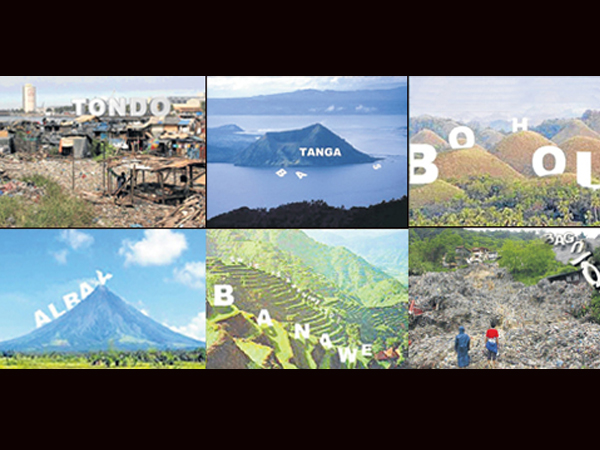
SIGN(S) OFF Signs a’la f Hollywood Hills go viral on Thursday. Photos are from Facebook users Dennis Garcia, Peter Pinder, Macky Pamintuan, Chanot Cangao, Ryan Giron, Louie Aquino, and Hollywood Pilipinas Facebook Page.
It triggered an eruption of ridicule.
A plan to erect giant letters on Taal Volcano Island similar to the iconic “Hollywood” sign in Los Angeles, California, drew lava-hot criticism and Internet spoofs on Thursday, mostly directed at its proponent, the award-winning actress and Batangas Governor Vilma Santos.
Netizens with PhotoShop skills particularly feasted on the scheme, which was recently endorsed by the provincial council as a potential tourist attraction. The plan, according to Vice Governor Mark Leviste II, was to put up 14-meter-high letters spelling out  “BATANGAS” along the contours of the scenic volcano.
Taal Volcano, world-famous for its location within a freshwater lake, became a popular trending topic on Twitter and on Facebook pages, which mocked and rallied opposition to the plan.
Parodies quickly went viral: “Photos” of other famous Philippine landmarks marked with white, boldfaced nametags spread across the Web.
In an interview with the Philippine Daily Inquirer, Santos on Thursday appealed to the public not to “overreact,” saying the plan was “not yet final” and still subject to consultations.
“It’s not as if it’s a done deal or there’s already an allocated budget for the construction. It was just a plan that was tackled in a meeting,” the governor said on the phone.
Horrific
But the firestorm has already started. Singer-composer Jim Paredes tweeted: “This is horrific. Vilma Santos et al, wake up!”
Controversial tourism and reproductive health advocate Carlos Celdran launched a Twitter campaign dubbed “NOtoBATANGAS sign.”
“Why spoil a natural beauty? Why the need to copy Hollywood? This is God-given natural beauty and nothing can be added to (further) beautify it,” a user named Glenn posted on the Inquirer website.
“I don’t see the logic. It will just destroy and cover the beauty of Taal itself,” said another reader.
Facebook user Bing Yenko Kasilag wrote: “NO NO NO TO THIS!!! Ate Vi, please leave Taal Volcano and the lake alone. Do not mar the natural beauty of the scenery. It doesn’t belong to Batangas alone but to the entire nation. Get rid of the all illegal fish pens instead.”
A newly opened Facebook group named “Hollywood Pilipinas” had one post that asked: “Why not just brand the whole country that way?”
Leviste on Wednesday said the Sangguniang Panlalawigan approved a resolution on October 5 supporting Santos’ idea.
He said having the sign would also assert the “identity” of Taal as part of Batangas and not of Tagaytay City, which has a thriving tourism industry owing to its spectacular view of the volcano and the lake. Tagaytay lies in the neighboring province of Cavite.
Tacky, a waste of taxes
Other netizens called the plan “ridiculous and tacky” and “a stupid, ugly and a waste of taxpayers’ money.”
Ivan Henares, vice president and trustee of Heritage Conservation Society, wondered on Twitter: “How could Taal Volcano be honored as a Unesco World Heritage site if it won’t be taken care of?”
And on his group’s Facebook page, Henares added: “It won’t stand a chance kung matuloy yan (if that plan pushes through).”
‘Don’t be personal’
In a statement addressed to critics and posted on INQUIRER.net, Leviste echoed Santos’ explanation, saying the provincial government was “still in the process of studying the idea.”
“I will welcome and appreciate any and all comments, ideas, suggestions even objections for as long as it is not personal.  Thank you!” said the vice governor.
“That’s why we conducted a public consultation/committee hearing regarding the proposed Batangas sign—to study all possibilities. We also informed the different government agencies about the said hearing so that we can record all their inputs,” he said.
Barrage of comments
Santos said she was greeted by a barrage of “negative comments on the Internet” when she woke up Thursday.
She said the proposal to put up a huge sign on the island had been discussed with the Protected Area and Management Board, which is tasked to oversee the lake and the volcano.
The board, Santos noted, included representatives from the Department of Environment and Natural Resources (DENR), the private sector, fisherfolk organizations and the mayors of the towns surrounding Taal Lake.
In that meeting, various suggestions were made on how to best protect and promote Taal Lake as a provincial treasure. “We wanted a landmark that will identify Taal as part of Batangas,” she stressed.
But Santos said what was actually suggested was a sign that would read “Ala Eh”—a Batangueño expression—and not “Batangas.”
This was contrary to Leviste’s announcement, which was also reported on the website of the government-run Philippine Information Agency on Wednesday.
She said there had been a widespread misconception that Taal was part of Tagaytay since the latter offered “the best views of the lake and volcano.”
But again, she maintained, “we have to study the plan carefully and consult various government agencies, including the DENR and Phivolcs (Philippine Institute of Volcanology and Seismology) first.”
Fishkill aftermath
In the aftermath of the massive fishkill that hit Taal Lake earlier this year, the provincial government had been working double-time to come up with  “alternative livelihood projects for those who will be displaced by the closure of fishpens,” Santos said.
It was in this light that the idea of converting the lake into an ecotourism destination was brought up, she said. “Tourism would spell more jobs in the province.”
By reclaiming Taal Lake and Volcano as their own, “the people of Batangas will hopefully learn to cherish and protect it,” she said.
Santos said it also saddened her that the issue got blown out of proportion because of “politicking” and the noise it was generating could be used by her political opponents in time for the 2013 elections.
“Bahala sila sa buhay nila (Let them have their way). I have no time for politicking,” said the governor, who is on her second term and could still run for a third. “I’m not motivated by self-interest. I am just here to serve the people of Batangas the best way I can.”
Also, she said: “We are not fighting with the people of Tagaytay. There’s no bad blood between (its) Mayor Abraham Tolentino and Batangas. In case of a natural calamity, Tagaytay will be our partner in evacuating and saving our people.” With a report from Ana Roa, Inquirer Research

Gadhafi killed after cornered in sewage pipe


 6share35 29

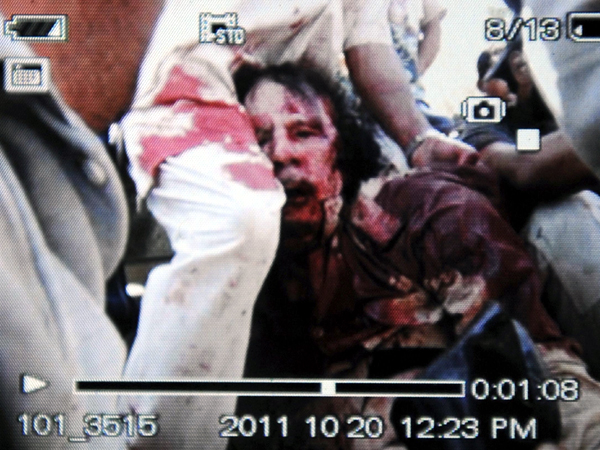
INGLORIOUS END Al Jazeera Television reported that the body of the ousted Libyan leader, Moammar Gadhafi, had a bullet hole in the head, was dragged along the streets and stripped of his shirt amid the jubilation of freedom fighters. AFP
SIRTE—Moammar Gadhafi was killed Thursday in a final assault on his hometown Sirte by fighters of the new regime, who said they had cornered the ousted despot in a sewage pipe waving a golden gun.
The demise of the hated dictator, who ruled his oil-rich North African nation with an iron rod for close on 42 years, sparked a spontaneous outpouring of joy and celebratory gunfire in streets across Libya.
“We announce to the world that Gadhafi has died in the custody of the revolution,” National Transitional Council (NTC) spokesman Abdel Hafez Ghoga said in the eastern city of Benghazi.
“It is an historic moment. It is the end of tyranny and dictatorship. Gadhafi has met his fate,” he added.
Jubilation in Tripoli
In Tripoli, interim premier Mahmud Jibril said NTC leader Mustafa Abdel Jalil was to declare by Friday that the country has been liberated, paving the way for the formation of an interim government ahead of elections.
As Libyans danced for joy in the streets, world leaders welcomed Gadhafi’s demise as the end of despotism, tyranny, dictatorship and ultimately war in Libya.
Waving a golden gun
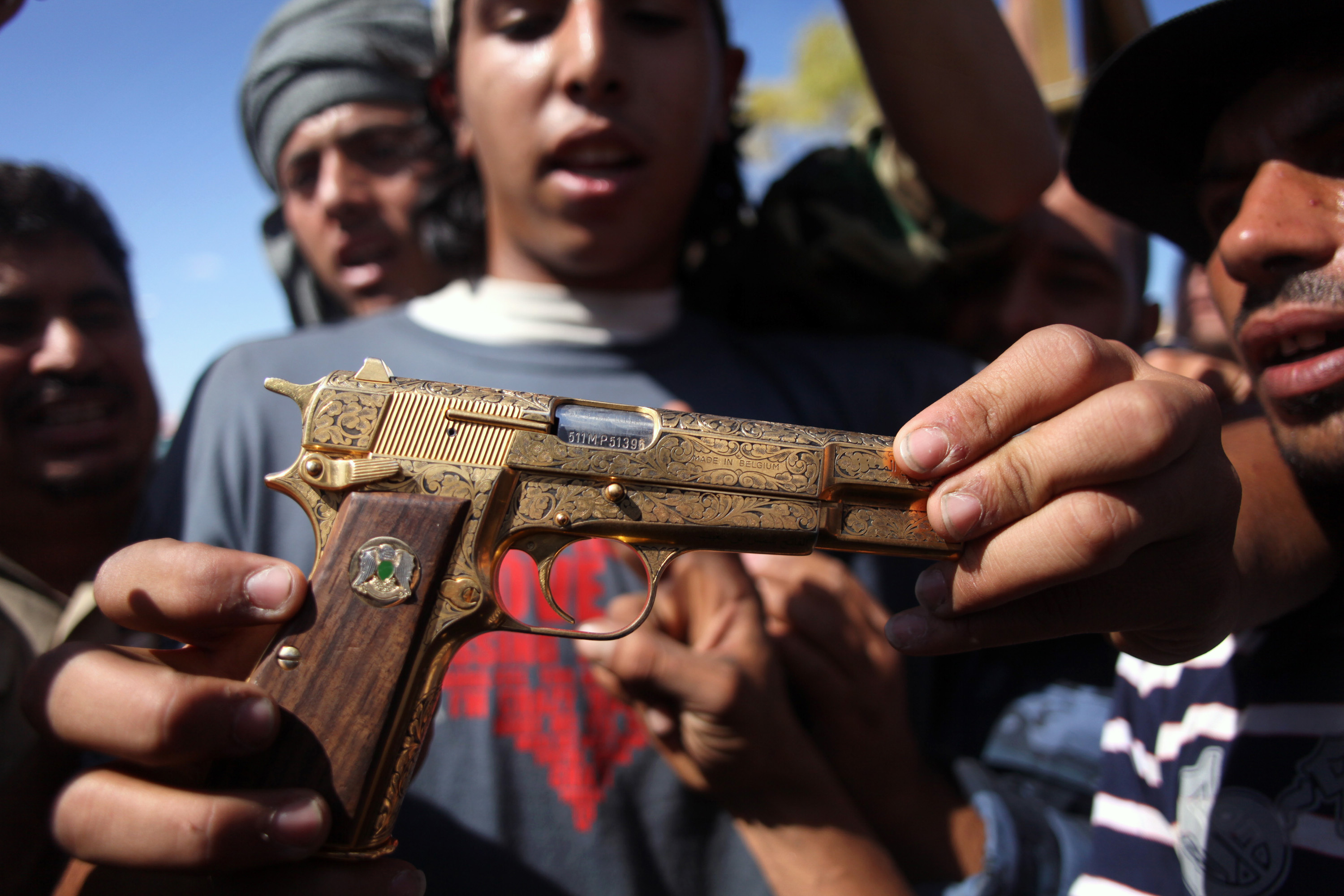
Colonel Gadhafi, whose whereabouts were unknown since NTC fighters overran the capital in August, was captured in a sewage pipe waving a golden gun near Sirte, Libyan fighters said.
“Gadhafi was in a jeep when rebels opened fire on it. He got out and tried to flee, taking shelter in a sewage pipe,” an NTC field commander, Mohammed Leith, told AFP.
NTC fighters “opened fire again and he came out carrying a Kalashnikov (assault rifle) in one hand and a pistol in the other,” he said.
Gadhafi “looked left and right and asked what was happening. Rebels opened fire again, wounding his leg and shoulder. He died after that,” according to Leith.
Shot in the head

Gadhafi's golden gun
But according to Jibril, Gadhafi was shot in the head “in crossfire” between his supporters and new regime fighters after his capture.
“When he was found, he was in good health, carrying a gun,” Jibril told a press conference in Tripoli. Gadhafi was transferred from the sewage pipe to a pickup truck, at which point he was shot in the right hand.
“When the vehicle started moving, it was caught in crossfire between Gadhafi fighters and the revolutionaries, and he was shot in the head,” according to Jibril.
“He was alive up to last moment, until he arrived at hospital” in the town of Misrata.
French intervention
French Defense Minister Gerard Longuet revealed that a French Mirage-2000 fired a warning shot at a column of up to 80 vehicles trying to flee Sirte early Thursday.
Libyan fighters then intervened, destroying the vehicles, from which “they took out Colonel Gadhafi,” he added.
Longuet told reporters in Paris that the convoy “was stopped from progressing as it sought to flee Sirte but was not destroyed by the French intervention.”
Inglorious end
A videotape aired on Arab satellite channels showed a bloodied Gadhafi alive and walking as he was being manhandled by Libya’s new regime fighters after his capture.
NTC fighters circled the 69-year-old ousted strongman, who was bloodied in the head, face and shoulders, as he apparently tried to cry out.
Leith, the NTC commander, said one of Gadhafi’s sons, Mutassim, was also killed in Sirte. “We found him dead. We put his body and that of (ex-defense minister) Abu Bakr Yunis Jabar in an ambulance to take them to Misrata.”
The NTC’s Jibril said that Gadhafi’s most prominent son and one-time heir apparent, Seif al-Islam, was believed to be pinned down in a village near Sirte.
Witnesses said they saw the bodies of both Gadhafi and Mutassim in Misrata late on Thursday.
“I saw his body, he had a wound on his head,” said one witness, Hakim al-Farjani.
“There was a lot of blood on his body. He had a bandage on his stomach,” he said. “The body came in an ambulance. Then the crowd became bigger and bigger so they took the body away.”
An AFP photographer also saw Mutassim’s body after it had been transferred to Misrata.
News of Gadhafi’s death came as new regime troops overran the last redoubt of his loyalists in Sirte, bringing to an end a two-month siege.
Fighters moving in from east and west overcame the last resistance in the city’s Number Two residential neighbourhood where his diehard supporters had been holed up.
“Sirte has been liberated, and with the confirmation that Gadhafi is dead,” Libya has been completely liberated, a top NTC military official, Khalifa Haftar, told AFP in Tripoli.
‘Allahu Akbar’
Fighters who had fought in the bloody eight-month conflict that toppled the despot at a cost of more than 25,000 lives, erupted in jubilation, firing volleys of gunfire into the sky and chanting “Allahu Akbar” (God is greatest).
Pick-up trucks blaring out patriotic music criss-crossed the streets of Sirte as fighters flashed V for victory signs and chanted “Allahu Akbar” (God is greatest).
“We did it! We did it!” chanted the fighters overcome with emotion, exchanging well-wishes, hugs and handshakes against a backdrop of intense celebratory gunfire.
World reacts
World leaders began to weigh in on the death of the man who had ruled the oil-rich nation.
US President Barack Obama said Gadhafi’s death ended a long, painful chapter for Libyans and warned “iron fist” regimes in the rest of the Arab world they would inevitably fall.
Speaking in the White House Rose Garden, Obama said Gadhafi’s demise vindicated the collective military action of the West and said Libyans now had a chance to build a “democratic” and “tolerant nation.”
British Prime Minister David Cameron said the death was an occasion to remember his victims, while hailing it as a chance for a “democratic future” for Libya.
French President Nicolas Sarkozy also hailed the end of Gadhafi and urged the country’s new regime to pursue democratic reforms.
French and British forces spearheaded the air campaign against Gadhafi’s military by the NATO military alliance, which has launched nearly 1,000 strike sorties since March 31.
NATO withdrawal
NATO chief Anders Fogh Rasmussen said the alliance will begin Friday winding up its six-month mission in Libya.
Arab League chief Nabil al-Arabi he hoped the death of Gadhafi would “turn the page of tyranny.”
Arabi urged Libyans to “overcome the wounds of the past and to look to the future with no grudges or sentiments of revenge, warding off all that could disrupt national unity and peace.”
‘Historic transition’
UN chief Ban Ki-moon said it ushered in a “historic transition” for Libya.
“The road ahead for Libya and its people will be difficult and full of challenges. Now is the time for all Libyans to come together,” he said at the UN headquarters.
Medics said at least three NTC fighters were killed and 30 wounded in Thursday’s fighting in Sirte, after 18 were killed and around 180 wounded over the previous two days.
Fifty pro-Gadhafi fighters were killed and 150 taken prisoner, including three women, said NTC commander Leith. There was no independent confirmation of the toll.
Originally posted at 04:39 am | Friday, October 21, 2011

Wednesday, October 19, 2011

Vietnam Memories


By GEMMA CRUZ ARANETA
October 20, 2011, 12:12am
MANILA, Philippines — The most thrilling moment of my three-week trip to Vietnam in 1968 was perhaps that visit my husband and I made to an anti-aircraft battery station somewhere below the 20th parallel, in  the province of Thanh Hoa then devastated by the war.
The Socialist Republic of Vietnam with whom we have had fruitful diplomatic relations for the past 35 years had not been formed as Vietnam was still divided into north and south.
In a rice field, there were several artillery pits cleverly camouflaged among banana trees and, of all things, flowers. This is the battlefield, I muttered to myself, as I stood on the platform of an anti-aircraft gun, absolutely fascinated.
I ran my hands gingerly on the enormous deadly bullets before me and noticed that there were hundreds more kept in wooden crates neatly stacked  against the earthen walls of that pit.
There were soldiers, all young, with straw-covered helmets  that looked like hornets’ nests and I was instructed to hold on securely as they were about to revolve the platform and adjust the gun as if aiming at an approaching enemy (read American) plane. The commander brandished a red flag and shouted, “Ban!” That was the order to fire.
Mr. Doan Tuc, our interpreter - guide, had an unexpected and moving reunion with a nephew, one of the soldiers detailed to that particular unit. They had lost touch because of the war and had not seen each other for six years.
Filled with emotion, Mr. Tuc said his nephew was a young boy when he last saw him.” Now he is a man! He has changed so much because of the fighting.”
But the North Vietnamese did not fight with guns alone. Had they done so, they would have all been annihilated early on without winning a single battle.
Proudly,  they won the  20-year war against the most formidable adversary, the United States, who was then the wealthiest and the most powerful country with weapons inventory that consisted of brutally sophisticated weapons that included steel pellet bombs that maimed for life, delayed-action bombs, the dreaded napalm, and an array of toxic chemicals that turned the earth into barren uselessness.
Yet, North Vietnam fought valiantly with every single man, woman,  and child who believed that their cause was just. Her most potent weapon never registered in the Pentagon’s world-class and cutting-edge computers – a people’s unassailable and almost fanatical determination to win.
From then President Ho Chi Minh to the most obscure carabao boy, there was nothing more precious than independence. They preferred to suffer war than live in peace on their knees and  without independence. Look at them now! (gemma601@yahoo.com)

Philippine-American war artifact returned


By ROY C. MABASA
October 19, 2011, 3:05pm
MANILA, Philippines — After 112 years, two bells supposedly taken from a church in Meycauayan, Bulacan during the Philippine-American War by an American soldier and brought to the United States as a souvenir will soon travel back to its land of origin.
Strikingly, the return of what Foreign Affairs Secretary Albert del Rosario described as “a priceless piece of our heritage" was made at the time that the Philippine-American History Month is being celebrated.
In a statement, Del Rosario welcomed the return of the bells by the Sisters of Mercy in Omaha to the Philippine government and people through the Philippine Consulate General in Chicago.
“(The return of) this artifact...at this point of our history is a demonstration of the commitment of both the Philippines and the United States to further solidify our close relations for the mutual benefit of our peoples," said Del Rosario.
Earlier, the Consulate reported to the Department of Foreign Affairs that it has successfully recovered the artifact that was reportedly taken from a Meycauayan church in 1899.
The bells are attached to a hard black wood with a metal handle on top. It is not readily evident what purpose the bells serve in a church. They could be Sanctus bells, although many Sanctus bells are groups of three to five bells.
A placard on the block of wood says the bells were taken from a church in Meycauayan, Philippines, “after bombardment by Utah Battery March 29, 1899 by P. O. Thomas, Co. A Battalion of Engineers."
No research yet has been done towards the verification of the information contained in the inscription.
Consul General Leo M. Herrera-Lim, accompanied by his wife Fidelis, traveled to Omaha in Nebraska on October 8 to formally receive the artifact from Sister Judith Frikker, RSM, president of the Sisters of Mercy West Midwest Community.
“We are pleased to return this treasure to the Philippine government and its people,” Sister Judith told the Consul General.
“Our hearts are heavy knowing the loss that this piece represents, and we pray for an end to all war,” she added.
According to Archivist Monte Kniffen of the Sisters of Mercy in Omaha, he found the artifact in July from a set of properties that were originally in the possession of the Sisters of Mercy convent in Red Bluff in California.
It is unknown who gave the bells to the convent but Kniffen said that perhaps a small museum or a family could have turned it over to the convent after noting that they were church bells.

Container van school rises in Smokey Mountain


October 20, 2011, 4:19am
MANILA, Philippines — Have you heard yet of a school made out of container vans? Unbelievable but it’s true. And the grade school now stands proudly at the foot of what used to be Smokey Mountain dumpsite in Tondo, Manila.
The person who started the project is British national Jane Walker, a leading force of the Philippine Christian Foundation (PCF). She thought that a project like a school made out of container vans, donated by generous supporters, can help bring educational opportunities to children who are out-of-school and scavenging in Tondo. The container van school now accommodates a good number of marginalized pupils up to Grade Four.
Recently, the container van school, under the auspices of the PCF, was opened in simple ribbon-cutting ceremonies.
Gracing the occasion were officers of the British Embassy, led by Gerome Vizmanos, Gretchen del Rosario, Mark Allen Sison, Geof Lucraft, Paul Harmston, Cecile Tayag and Jane Walker herself, as well as the generous supporters from various sectors of the government agencies.
Among those who supported and donated classrooms are Victoria Court, including ABC International School, ABC, KSPACE & Wilowbrook Int’l. Schools, APL, Archion Architects, Australian Embassy, Boysen, British School Manila, Holcim Cement, Hyder, International School Manila, KSPACE International School, Pedro &Dionesia Esteves, PSF, PLDT, Smart, Motolite & PBSP, Rotary Club of Makati, Openwork Foundation, SHOM & IBF, The Body Shop, The Canticle Singers Malaysia, Tokyo International School, and Willowbrook International School.
The container van school hopes for a much better future for the out-of-school children. It is as well an ideal model or blueprint for giving access to education to the poorest of the poor in all parts of the country where school buildings are hard to come by.